
Singapore's Four National Taps are four ways of meeting the country's water needs: local catchment water, imported water, NEWater and desalinated water. The names describe a supply strategy. Their routes include reservoirs, waterworks and industrial customers, rather than four separate pipes under each kitchen sink. PUB's Singapore Water Story introduces the system.
Following each route makes it easier to understand where treatment happens and which uses it serves.
Collecting rain across the city
Rain moves through drains, canals and rivers into reservoirs before drinking-water treatment. Singapore collects it separately from used water, which goes through underground sewers to water reclamation plants. PUB monitors raw reservoir water with sampling and sensors. Its local-catchment explanation, updated in October 2026, describes these collection systems.
Reservoir water still needs treatment before it is distributed for drinking. A clear-looking urban waterway is not a drinking outlet; visitors should not drink directly from it.

Taking water from the Johor River
The imported-water route begins with raw water drawn from the Johor River and treated at PUB's Johor River Waterworks. Upstream, Linggiu Reservoir releases water into the river to supplement its flow and support the intake. PUB's imported-water account explains how the two work together.
Linggiu provides storage and flow support. The river is the place water is collected, and the waterworks provides drinking-water treatment. Keeping these jobs separate helps when following the route on a map.
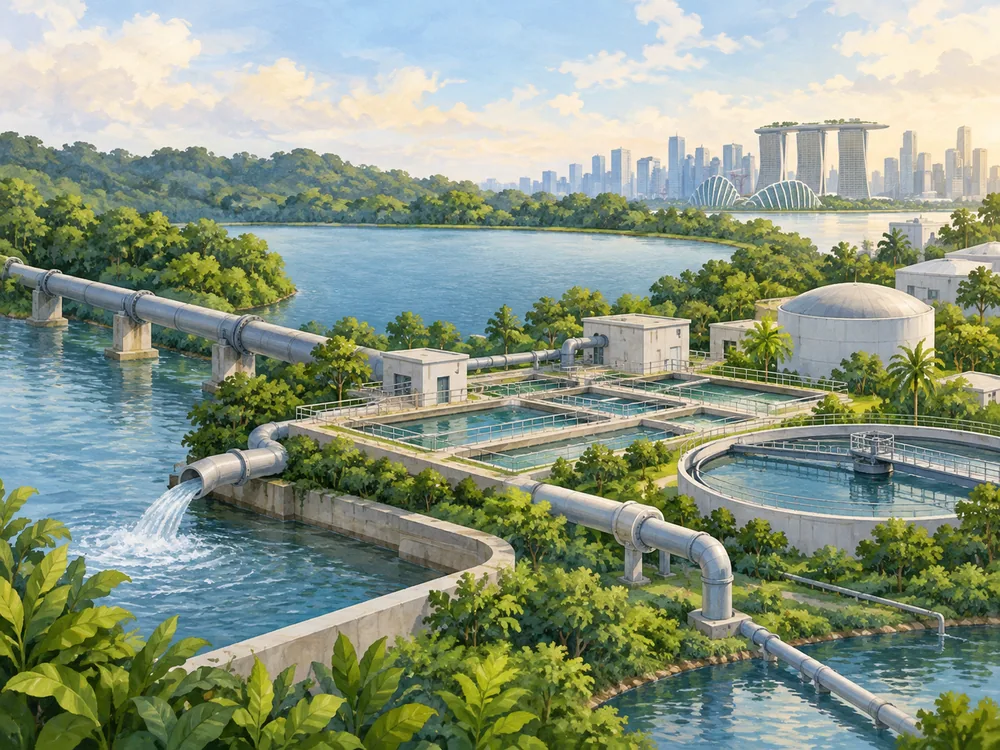
Using NEWater for industry and reservoirs
NEWater starts as treated used water, then goes through membrane purification and ultraviolet disinfection. PUB says its main uses are industry and air-conditioning cooling, with industrial customers served by a dedicated pipe network.
During dry periods, NEWater is also added to reservoirs. The blended raw water then passes through waterworks before reaching consumers as tap water. PUB calls this indirect potable use in its NEWater explanation. It is a different route from supplying households directly from a reclamation facility.
Industry is part of the national water strategy, so a source's contribution to water security cannot be read as its share of household drinking water. That share would need measurements and operating information for the relevant period.
Removing salt from seawater
Desalination supplies another route. PUB describes reverse osmosis as pushing seawater through membranes to remove dissolved salts and minerals. The sea supplies the raw water; processing produces the treated output. Its desalinated-water guide also identifies this as an energy-intensive process, which adds another reason to use water carefully.
The Four National Taps explain the country's options, without measuring today's blend at an individual address or inspecting a building's plumbing. Our Singapore water guide covers general visitor use. Check any notice that applies to your accommodation.