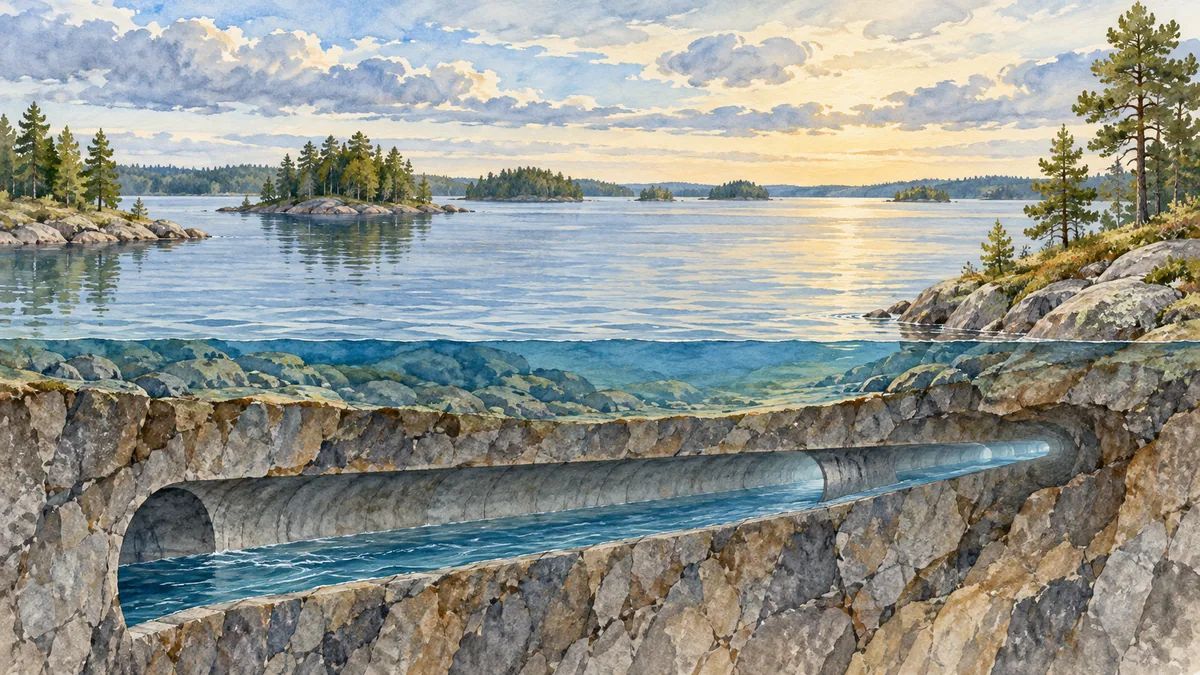
The history of Helsinki's Päijänne water tunnel has several starting dates because a company, a construction site and a working water route do not begin at the same moment. Keeping the milestones separate avoids making a partial opening stand for the completed system.
The official records describe a regional raw-water project. Its history explains how water came toward the Helsinki area; a present-day question about an accommodation still needs the relevant current supply information.
Start with the company, then the construction
HSY's account of Pääkaupunkiseudun Vesi and the tunnel dates the company's founding to 1972 and the start of tunnel construction to 1973. Those years describe different events.
A founding date belongs to the organization that arranged the undertaking. A construction date belongs to work on the physical system. Neither should silently become the date that the entire tunnel started supplying water. When saving a historical note, keep the event name beside its year.
The same care helps when a short travel article and a longer engineering history seem to disagree. Check what each author means by a project beginning. Planning, establishing an organization and excavation may all appear in an account without being competing dates for one event.
The first water arrived before the complete opening
HSY's 2020 evaluation report, dated 5 May 2021, says partial use began in 1979 and full use in 1982. The report's publication date is separate from those historical events.
The utility's 1982 history chapter dates the completed section's inauguration at Korpimäki to 29 May 1979. It describes Päijänne water supplementing the Vantaanjoki supply before the tunnel's final section was ready.
Preserve the word partial when summarizing the record. Early water movement does not establish completion of every remaining section. Equally, a later opening date does not mean no earlier section had been used. The records can describe both stages without contradiction.
Keep excavation and opening dates apart
The history chapter dates the end of the main tunnel excavation to 9 July 1981 and the full opening to 22 August 1982. Excavation ending and the complete system entering use remain separate milestones.
A caption attached to a construction photograph should follow the particular activity shown or documented. It should not borrow the final opening year simply because the photograph concerns the same project. Where an image has no established date or location, keep that uncertainty; a generic illustration cannot fill the gap.
These distinctions also matter when translating the history. Preserve whether a source means construction, excavation, partial operation or the complete opening. A smoother sentence should not make several events happen at once.
A raw-water tunnel is one part of the supply
HSY's current tunnel account describes raw water travelling from southern Päijänne to the Silvola artificial reservoir near the Pitkäkoski treatment plant. Its drinking-water quality page describes subsequent multistage treatment and monitoring of raw water, treatment and the supply network.
Conveying raw water and producing the water delivered to customers are distinct roles. The tunnel's opening history does not, on its own, document a present-day result at a household tap. Keep a construction anniversary separate from current reporting periods and property-specific questions.
The Helsinki city guide offers general travel guidance. For a historical inquiry, retain the named milestone and original record. For a current supply question, use HSY's current information and the accommodation's appropriate contact; the 2020 evaluation is not a new condition survey for your trip.