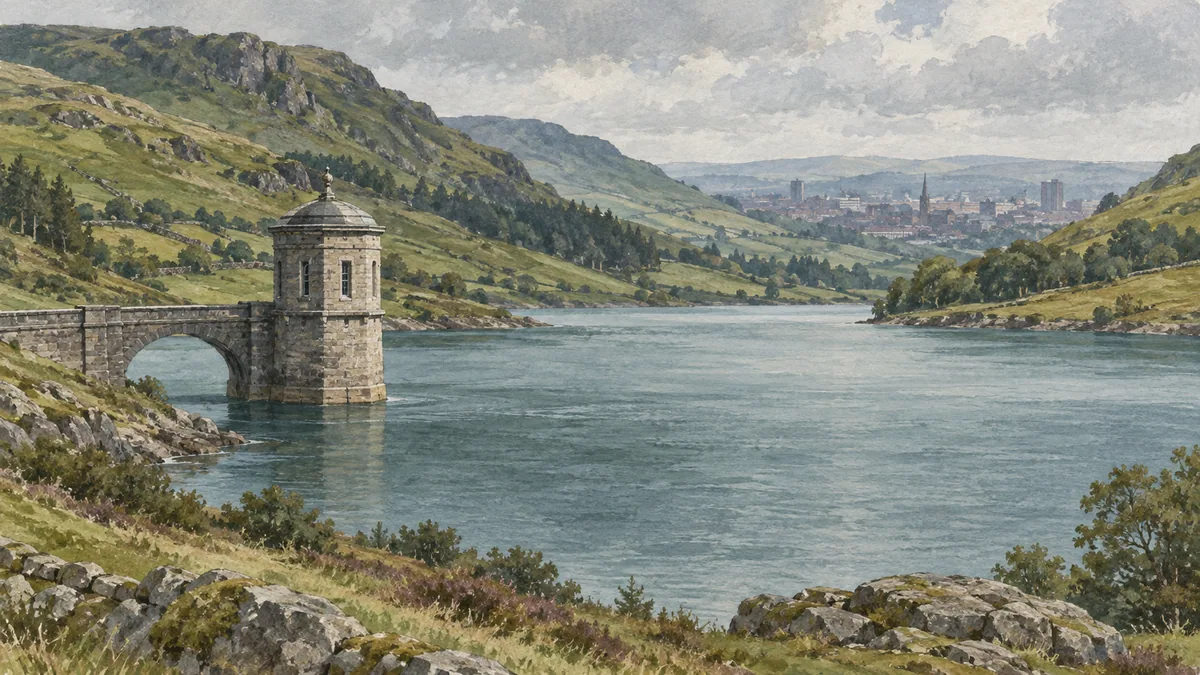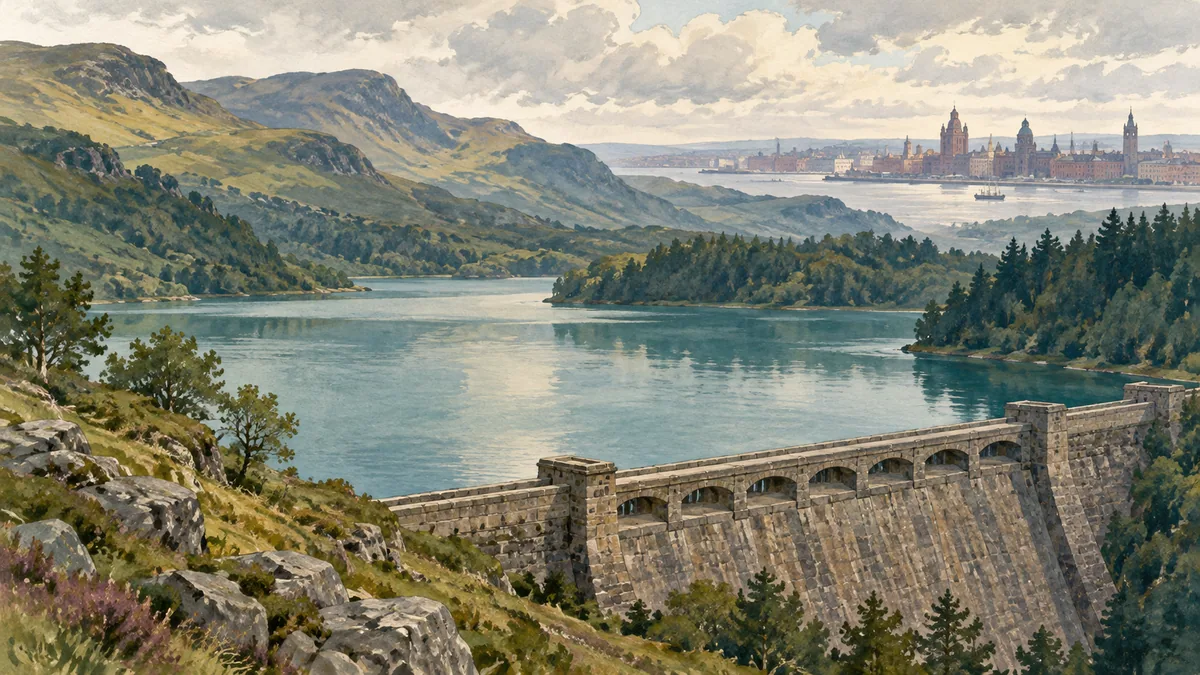
NI Water’s construction records put Silent Valley in Belfast’s water-supply history: the reservoir project was part of the city’s search for a dependable supply. Follow the early construction and later additions alongside the treatment record to see how that supply story developed.
The records give a clear historical connection. They do not tell us that every Belfast building receives the same route of water today. For that, the starting point is the utility’s local supply information rather than the age or appearance of the reservoir.
Construction dates describe different milestones
The first-sod ceremony took place on 10 October 1923, according to NI Water’s centenary account. Its anniversary marks the beginning of the project. It is easy to mistake that date for the moment the reservoir entered service.
The visitor-centre history says the reservoir opened in 1933. It also places Bignian Tunnel in 1952 and Ben Crom Reservoir construction in 1957. Those are separate milestones, not competing dates for the same event. In particular, a construction date should not become a claim about completion.
The interpretation traces the work back to the Belfast City and District Water Commissioners. That makes the city connection explicit. Reading the timeline as a sequence also avoids squeezing a long infrastructure project into one anniversary headline.
Storage and treatment are separate parts of the story
An account of a reservoir explains where water can be held. To follow the supply towards homes, another record is needed. NI Water’s Drumaroad upgrade announcement says Drumaroad Water Treatment Plant near Castlewellan treats water from Silent Valley.
That is a description from January 2020, not confirmation of when the announced work finished. The release is useful evidence of the reservoir-to-treatment connection; its proposed construction schedule needs its own later evidence before being described as completed.
NI Water’s catchment profile adds another detail: the Drumaroad entry lists Silent Valley and Lough Island Reavy reservoirs, together with the Annalong River. A story that names Silent Valley alone therefore leaves part of the documented source picture out. The list concerns sources for a regional system, not an address-by-address delivery record.
What the history can answer for a visitor
If you want to understand why the reservoir was built and how the system developed, the construction timeline and treatment account answer that well. Read the visitor-centre page for the historical account before going. Check current visitor information separately, because the construction history does not verify opening hours.
For the water at your accommodation, ask a narrower question: which local supply information applies to this postcode? NI Water offers water-quality and hardness information through a full-postcode lookup on its results page. We read the interface but did not enter a Belfast address, so there is no local result to report here.
Our Belfast guide gives the wider travel context. If a local notice affects your stay, use the utility’s notice for the address and read our guide to water notices for help distinguishing the instructions. For the accommodation, keep the utility’s dated local information alongside the wider history.