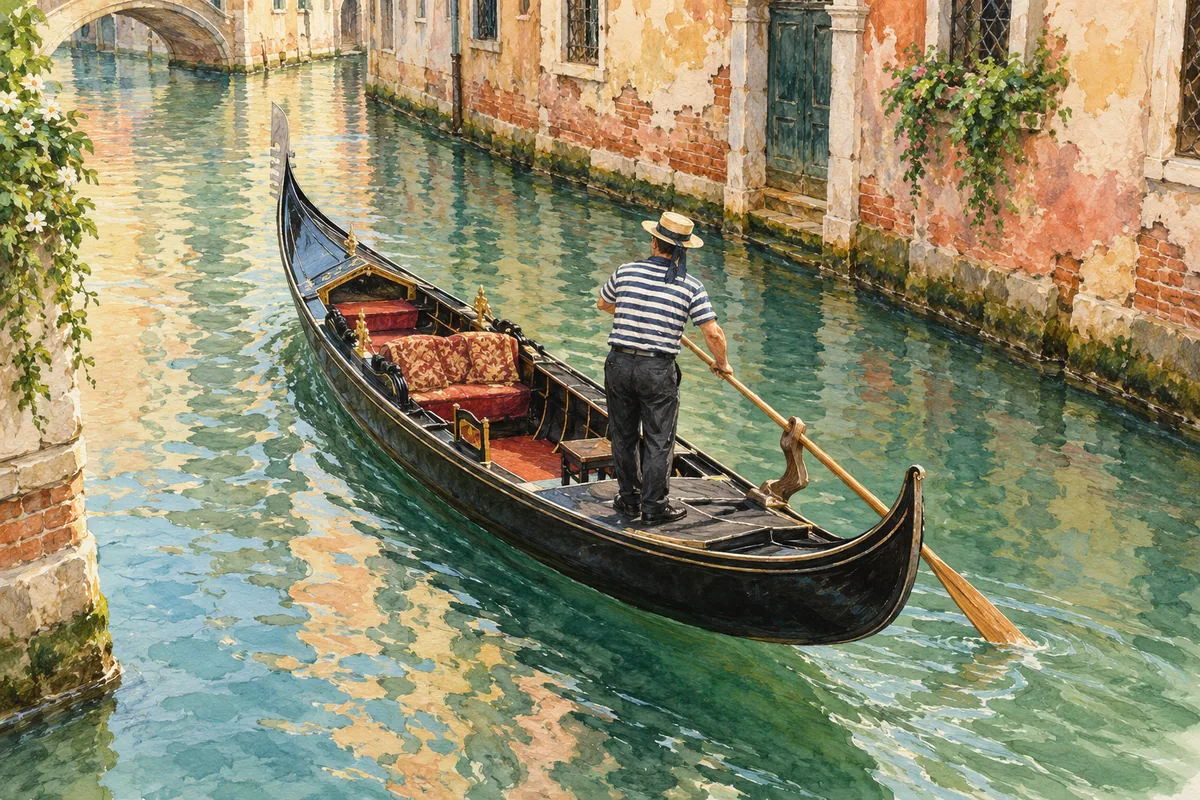
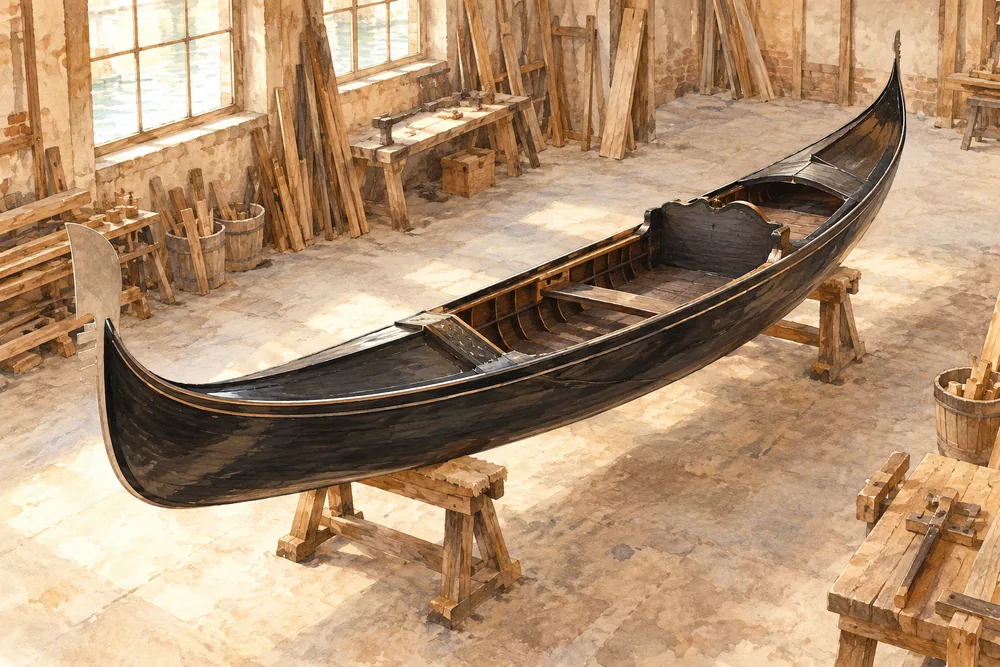
Venice’s gondolas have an uneven hull, or boat body, to work with a gondolier rowing from one side. Their unequal sides help keep the boat on course by countering the turning effect of a single oar, as the Mariners’ Museum’s gondola catalog explains.
One rower, one side
On a gondola with one rower, the gondolier works the oar on the boat’s right side, as the museum’s catalog explains. A stroke from that side tends to turn the hull to the left; its unequal shape helps counter that tendency. Here, right and left mean the boat’s sides when looking towards the bow, or front.
The asymmetric hull also offsets the weight of the gondolier standing aboard, according to the museum’s Small Craft Center overview.
The Small Craft Center’s example came from the Casal boatyard in Venice in the middle of the nineteenth century. The museum’s collection label describes that boat’s left side as wider around the middle of the hull.
A wooden rest that allows steering
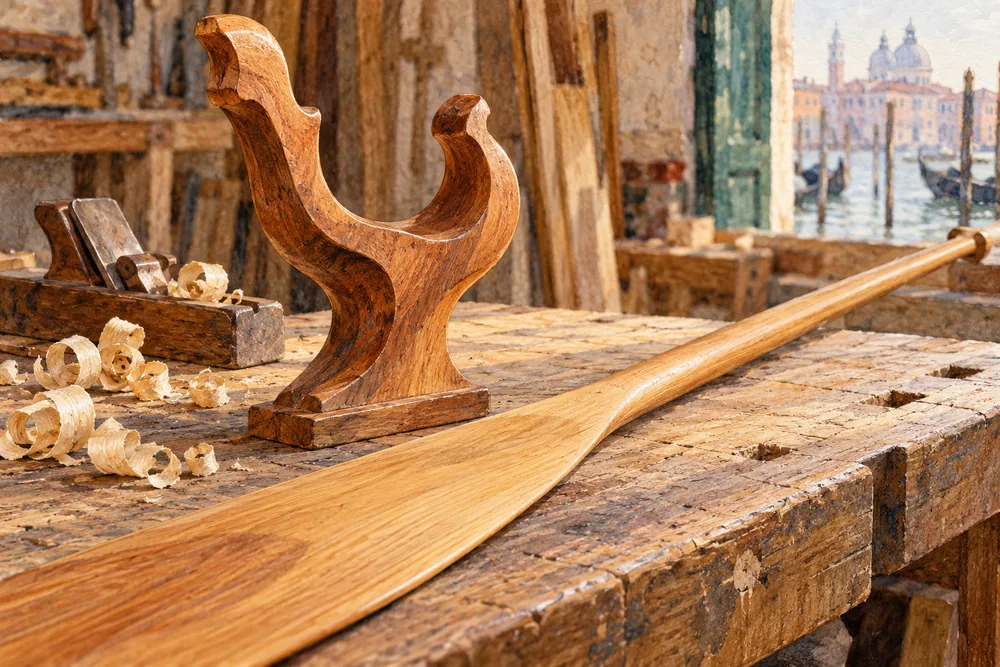
Beside the gondolier is a carved wooden support called a forcola, where the oar pivots. Oar maker Saverio Pastor explains that the forcola at the stern, or back of the boat, has several bearing points. The gondolier uses these different contact surfaces while manoeuvring.
Pastor also explains why the rower stands: narrow canals bordered by buildings call for a clear view and room to manoeuvre. He notes that an oar rest’s size and shape can vary with its rowing position, the rower’s build and their technique. The hull’s shape helps with handling, while the rower still directs the boat through the oar.
What to look for from the canal bank
The Fitzwilliam Museum’s definition of a gondola describes a long, narrow boat with a flat bottom, unequal sides and one oar.
On a canal walk, look at where the oar meets its wooden support, then follow the hull towards the bow. Watching the rower change the oar’s position can make the design easier to understand. From a distance, the raised ends and decoration may catch your eye first; the working connection sits beside the gondolier.