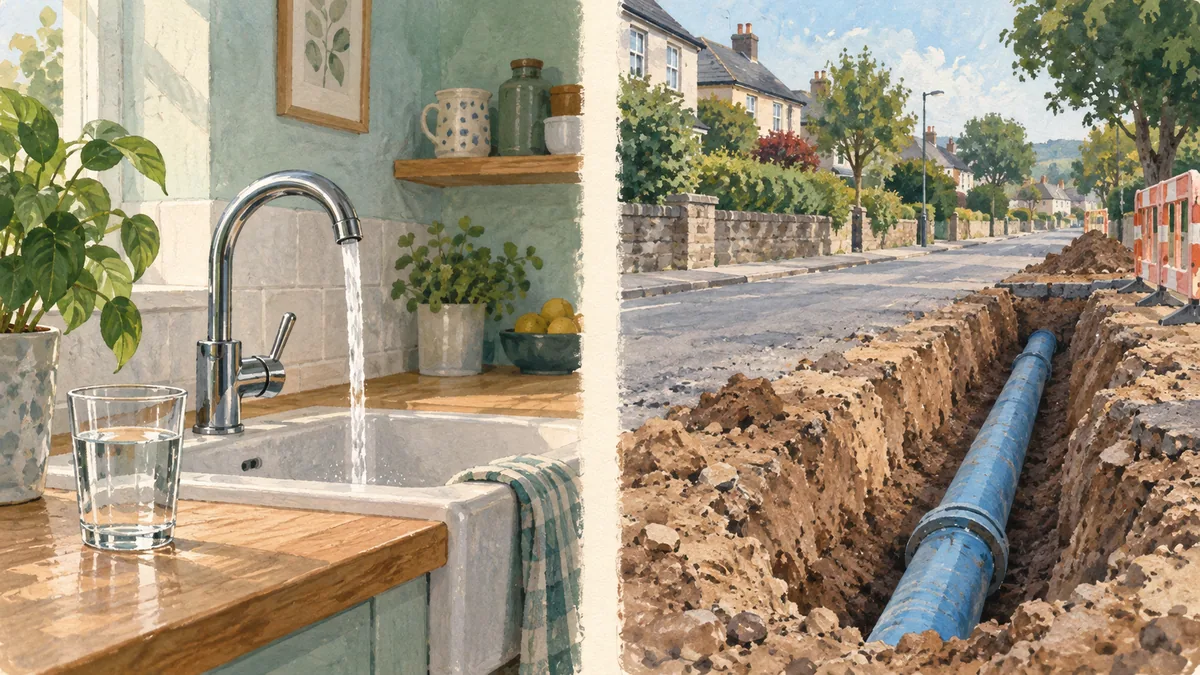
When a Munich visitor has a question about a kitchen tap, the supply network and the building installation need separate attention. The supplier's delivery point helps identify where the public account ends. The building's records help explain what happens farther along the route to that tap.
Munich's health department places delivery-quality responsibility with SWM up to the house connection, and building installations with the owners. Property management is its first contact for building complaints. For a guest, that makes the host or manager a sensible person to ask for the relevant building contact.
Find the delivery point in SWM's terms
SWM's supplementary supply conditions are valid from 1 February 2023. Clause 4.2 ends the house connection at the main shutoff before the water meter, in the direction of flow. Water is delivered there.
That is more precise than saying simply that responsibility changes at the meter. Keep the valve and the direction of flow in the explanation. A diagram that places the boundary after a meter would change the location described in these conditions.
Use the definition to ask a clear question, not to identify or operate unfamiliar equipment yourself. A visitor cannot establish which fitting is which by comparing a cupboard with a generic illustration. Ask the responsible person to identify the connection using the building's own installation records.

Ownership is a separate part of the account
Clause 4.1 gives the holder or customer ownership of the house connection and generally requires SWM for construction, maintenance and alteration. If the holder built a non-walk-in meter shaft, they maintain and repair it, its fixed metering equipment and the connection-pipe section fixed to it at their expense. Third parties may do this work or build the shaft. Differing individual agreements remain.
Ownership and the location where water is delivered therefore should not be collapsed into one rule. The owner of a fitting, the person arranging work and the party responsible for delivered-water quality can be different questions. Read the relevant clause before using one of those answers for another purpose.
If a host and supplier appear to describe different parts of the installation, ask which part each means. An address, the name of the connection document and a description of the actual concern are more useful than a statement that every pipe must belong to one party.
Ask for the right building record
SWM need not inspect or repair the customer's installation. A general supply statement consequently cannot substitute for the building's maintenance or inspection history. Ask management which records apply to the affected part of the premises, rather than requesting an unrelated citywide analysis.
SWM's laboratory page describes a separate household-water check for an initial overview of a home's installation. For elevated results from a self-collected sample, it recommends certified sampling and accredited analysis.
A test inquiry should explain the question before choosing a service. A report only becomes useful when its sampling point, method and date match the concern. An unrelated sample cannot inspect the apartment where you are staying, and the existence of a laboratory service does not mean your building has used it.
For a short stay, keep the steps practical: describe the problem to the host or manager and ask for the appropriate responsible contact. The Munich city guide provides general visitor context. Decisions about a particular installation need that property's records and the relevant professional; these published boundaries do not diagnose a defect or decide an individual contract dispute.