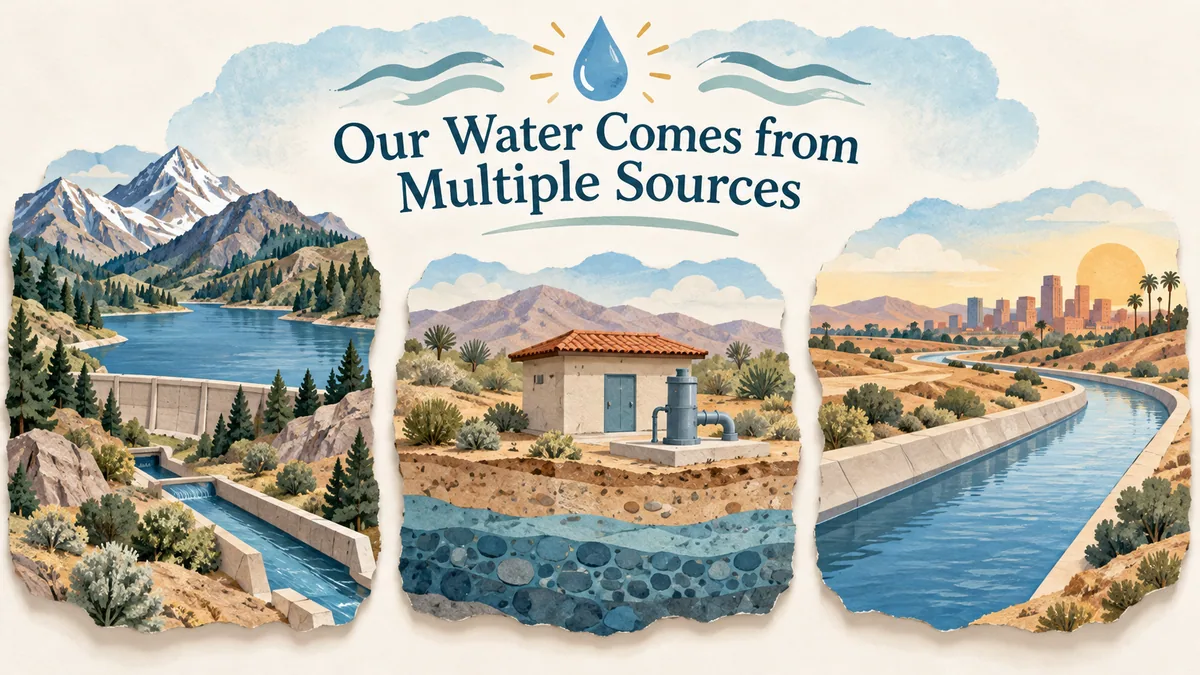
LADWP’s Los Angeles system draws on several sources: water brought through aqueducts, groundwater and purchases from another regional agency. The sources listed for a community and the amount used across a year answer different questions.
For a visitor, start by identifying the water provider for the address. The discussion below concerns LADWP’s Los Angeles system, not every water supplier across Los Angeles County.
Start with the utility’s source categories
LADWP’s Sources of Supply page names the Los Angeles Aqueducts, local groundwater and supplemental water bought from the Metropolitan Water District of Southern California, or MWD. Purchased water travels through the Colorado River Aqueduct and the State Water Project’s California Aqueduct.
MWD identifies the supplying agency; the accompanying aqueduct names identify the conveyance systems. Read those labels together rather than treating every named source as a separate household connection.
Groundwater also needs its geographic context. LADWP’s San Fernando Basin explanation describes the San Fernando Groundwater Basin as a natural underground reservoir. It supplies Los Angeles, Burbank and Glendale. That shared basin description does not tell a reader which well was pumping when a particular tap was opened.
Match the report to its year and community
The official report index currently points to its 2025 Drinking Water Quality Report. The report’s cover identifies 1 January through 31 December 2025. Opening it in 2026 does not turn its annual source account into a daily operating record.
Printed page 19 groups San Fernando Valley communities with Los Angeles Aqueduct, local groundwater and MWD State Water Project sources. Eastern and Harbor communities are listed with MWD State Water Project and Colorado River Aqueduct sources.
These are broad community categories. The asterisked entries also carry a footnote about source fluctuations with operational needs and water availability. Keep that footnote’s marked scope; it is not a measured blend for every address. A source category alone does not establish a proportion in the glass.

Read recycled-water uses and future projects separately
A recycled-water reference needs the intended use attached to it. LADWP’s recycling projects page describes irrigation and industrial uses as well as groundwater replenishment and a seawater-intrusion barrier. It also describes new projects at different stages of planning, design or construction.
Those uses and stages should not be collapsed into a claim that every recycled-water project is already delivering drinking water. Nor should an annual supply graphic be treated as a recipe for what reaches a kitchen tap. Use the project description to establish the intended use and operating stage.

Use the portfolio to ask a more precise question
LADWP identifies its Urban Water Management Plan as its resource-planning document. That is the place to investigate long-term supply strategy, while the annual report provides a defined reporting period and community context. Neither is a live dispatch log for an individual property.
When reading a source statement, keep the provider, report year, community and stated use together. Ask LADWP for more specific information if your question needs an address-level answer rather than assigning the citywide portfolio to that address.
The sources here were checked on 15 October 2026. Our Los Angeles city guide provides broader travel context. This article explains the portfolio and its limits; it does not calculate a household blend or establish a current tap-water test result.