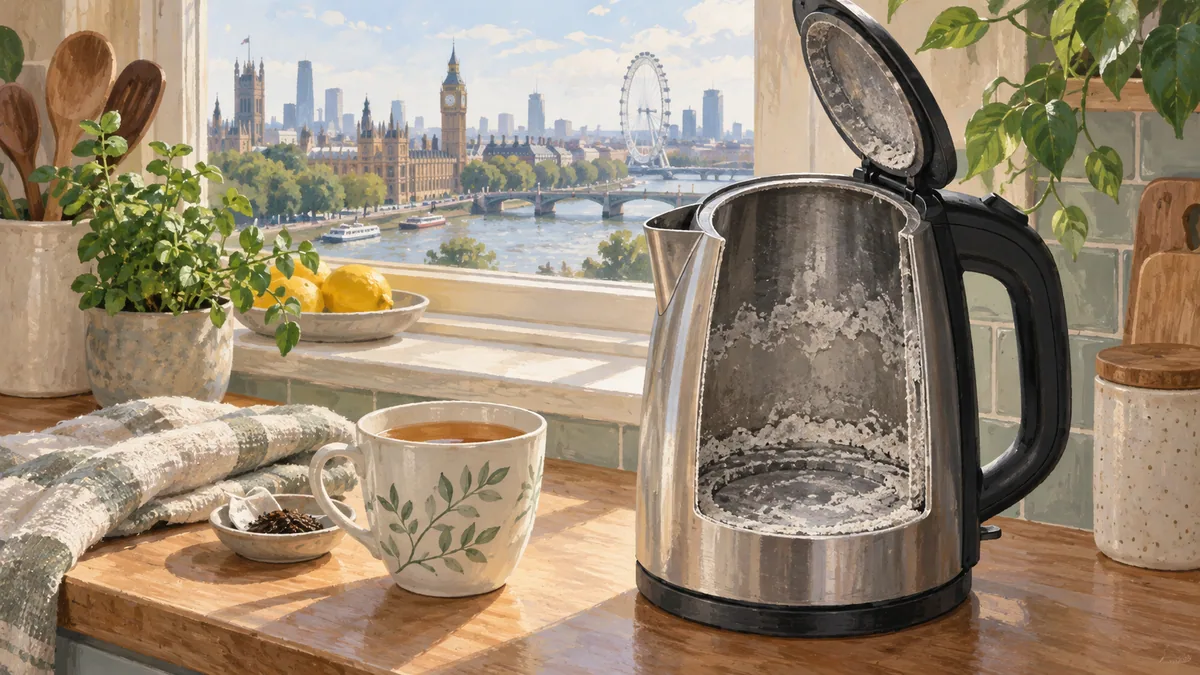
A chalky coating inside a kettle is a familiar consequence of hard water. Thames Water describes limescale as the residue hard water leaves behind. For a London kettle, understanding the water's hardness and the appliance's care instructions gives you a more useful starting point than choosing a treatment product straight away.
Why the scale appears
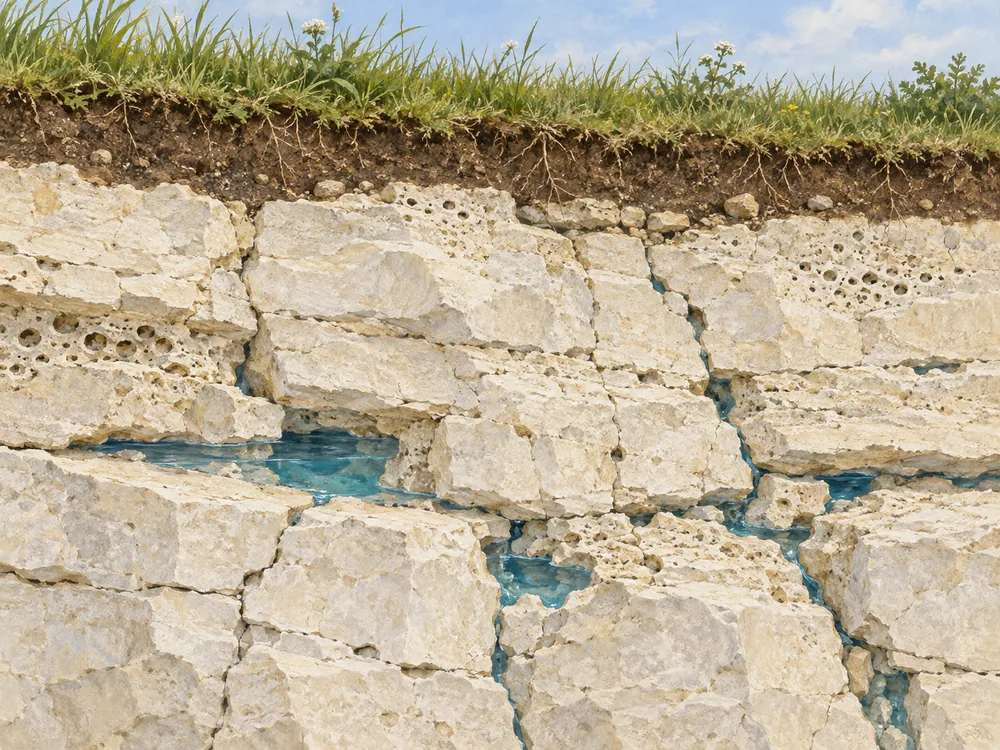
Hard water contains dissolved minerals, including calcium and magnesium. Thames Water attributes the hardness of its regional supply to water passing through chalky limestone. Hardness varies with local geology, so its hard-water guide gives no single current numerical value for every London address.
Some mineral hardness can be reduced by boiling; this portion is called temporary hardness. The Drinking Water Inspectorate explains that boiling water containing temporary hardness can form scale. That helps explain a deposit inside a heated kettle.
The deposit has limits as evidence. Our inference is that neither a scaled kettle nor a clean-looking one establishes whether the water meets every drinking-water requirement. Appliance deposits and water-quality concerns need different checks.
Look up the local hardness
Use Thames Water's postcode water-quality information for the accommodation. If another company supplies the property, ask that supplier instead. A general London figure may not apply to your rental or hotel.
For a report or an appliance setting, keep the address or supply area, reporting year, parameter and unit together. Then compare them with the instructions for the exact kettle or coffee machine. A shopping search alone cannot establish whether a product solves a deposit problem or a quality concern.
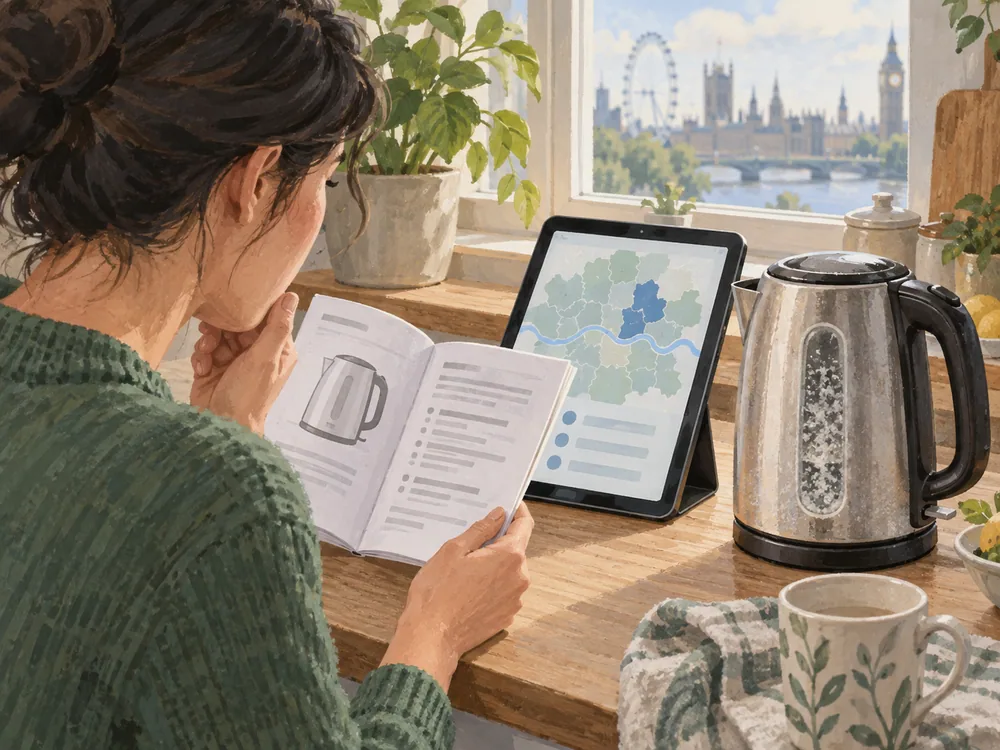
Descale according to the model's instructions
Bosch's TWK 3A series manual gives one example of model-specific care. It tells owners to unplug before cleaning, rinse the kettle and removable scale filter, and avoid hard objects that can damage the seal. Its descaling instructions allow vinegar or a commercial descaler.
Use your own model's instructions before choosing a method, including any concentration or soaking time specified. In shared accommodation, ask the host which approach is appropriate. A kettle and a coffee machine need their own care instructions even when filled from the same tap.
If the water itself looks cloudy
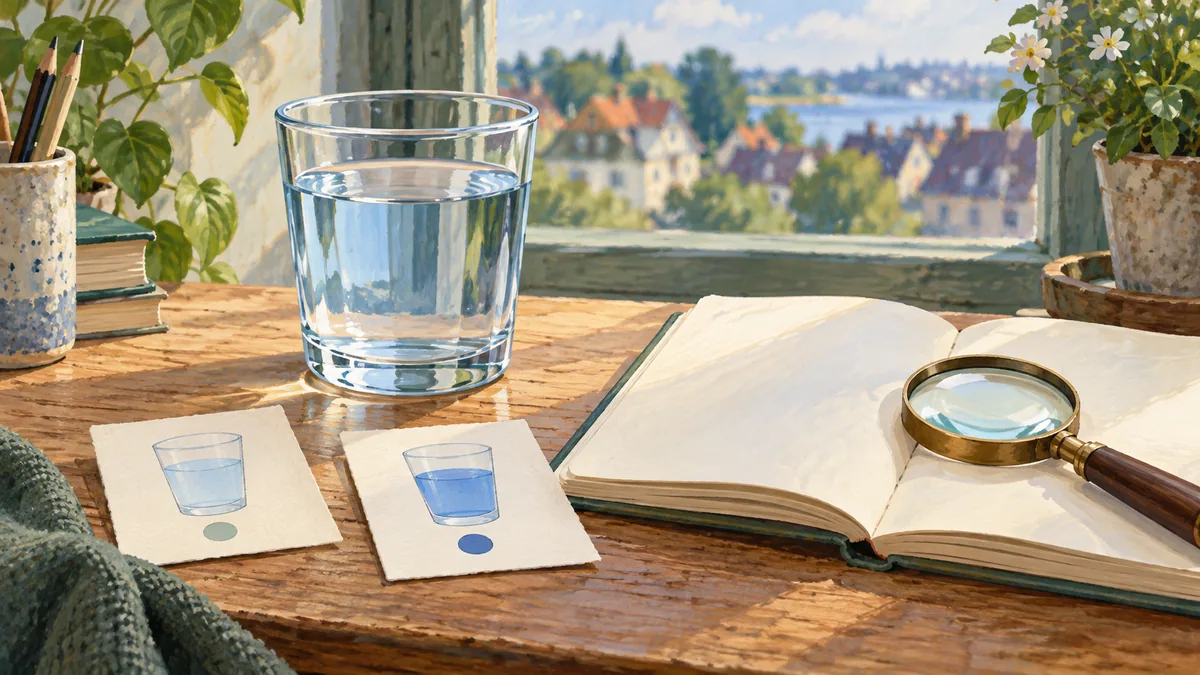
White cloudiness straight from a tap is a different observation from a kettle deposit. The Drinking Water Inspectorate says tiny trapped air bubbles commonly cause it. The cloudiness can clear from the bottom upwards when water stands in a glass.
The regulator advises contacting the supplier if it does not clear or comes with an unusual smell or taste. Its cloudy-water guidance explains this issue without treating every white appearance as limescale. Our London tap-water guide provides broader visitor guidance.
Optional hardness indicators
Check the exact kit’s parameter, unit, range and instructions before comparing a result with an appliance setting. A hardness indicator does not certify drinking-water safety.
🛒 Browse water hardness test strips on Amazon →Amazon paid link