Yorkshire Water's pipe guidance usually assigns the water main and communication pipe to the utility, and household plumbing and the supply pipe to the homeowner. For a Leeds property, the useful next step is to identify the named pipe section and its actual route. The nearest visible garden edge does not settle every arrangement. Whose pipe is it?
Follow the named pipe sections
Page 4 of Yorkshire Water's guide, labelled April 2026, shows the supply pipe from the property to the street boundary, and the communication pipe between that boundary and the main. It assigns the boundary stop tap, meter and chamber to the utility in the typical layout. Connection guide, page 4
Use those names when discussing a problem. A main serves the network; the smaller sections carry water towards the property. The guide's drawing explains the terminology; it is not a survey of a particular Leeds installation.
The homeowner's internal plumbing is another section again. A problem at an appliance, an internal valve or a buried supply pipe needs a description precise enough for the right person to investigate. If you do not know the route, say that rather than pointing to a line on a generic diagram as proof.
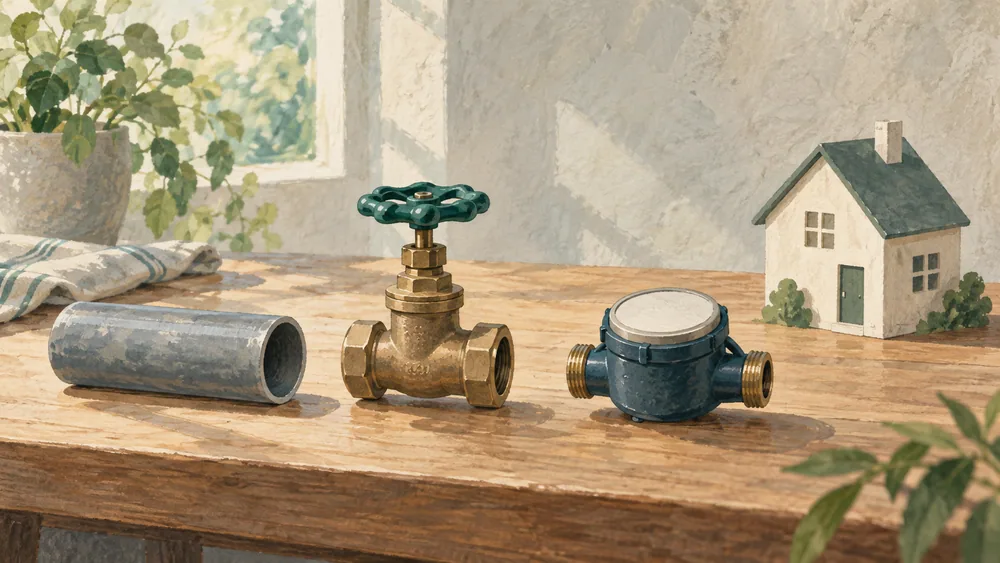
Exceptions beyond the garden boundary
The same guide says a main on private land can leave the owner responsible for the entire pipe from the property to the main. If the main is in another street, the owner's pipework responsibility can extend to that street's boundary.
Yorkshire Water's live pipe page likewise says a supply pipe under a public road or footpath can remain the customer's responsibility when the main is in a neighbouring street. A supply pipe through someone else's land also remains the customer's responsibility in that guidance. Public ground and utility pipe ownership are therefore different questions. Published exceptions
For shared supplies, the utility says the connected homeowners are jointly responsible for maintenance and repair. Ask it to confirm an uncertain shared arrangement; this article establishes no ownership, route or cost allocation for an individual property.
Describe the leak before choosing a repair
Yorkshire Water's property-leak guidance tells tenants and social-housing residents to contact their landlord or housing association to arrange repair. If you are staying temporarily, give the host the location of the visible problem and any changes you have noticed. Avoid arranging excavation or attributing a shared leak to one neighbour on the strength of a visitor's guess. Property leak guidance
The network-leak page provides a problem map and reporting route. It also says the meter and its connections belong to Yorkshire Water. Its external-stop-tap guidance limits renewals to circumstances such as an urgent health risk or a confirmed serious leak. Responsibility for an asset is not an unconditional promise to attend every request for private work. Network reporting and stop taps
Pipe responsibility and drinking-water results
These documents explain maintenance roles. They supply no laboratory result for your building's tap, and identifying a utility-owned section cannot establish the condition of the rest of the plumbing. Keep the repair question and the water-quality question explicit when asking for help.
Our Leeds tap-water guide covers broader visitor use. For a particular property, retain the utility's answer about the route and relevant responsibility alongside the repair records, and use a properly dated quality report for the separate question about the water.