
Bristol Water's regional supply draws from reservoirs, a canal and groundwater before treatment and distribution. Following that journey helps explain what the supplier means by a source, a treatment works or a supply zone. To identify the mixture at a particular Bristol postcode, you need the utility to connect that address to its account.
Several sources, with a changing balance
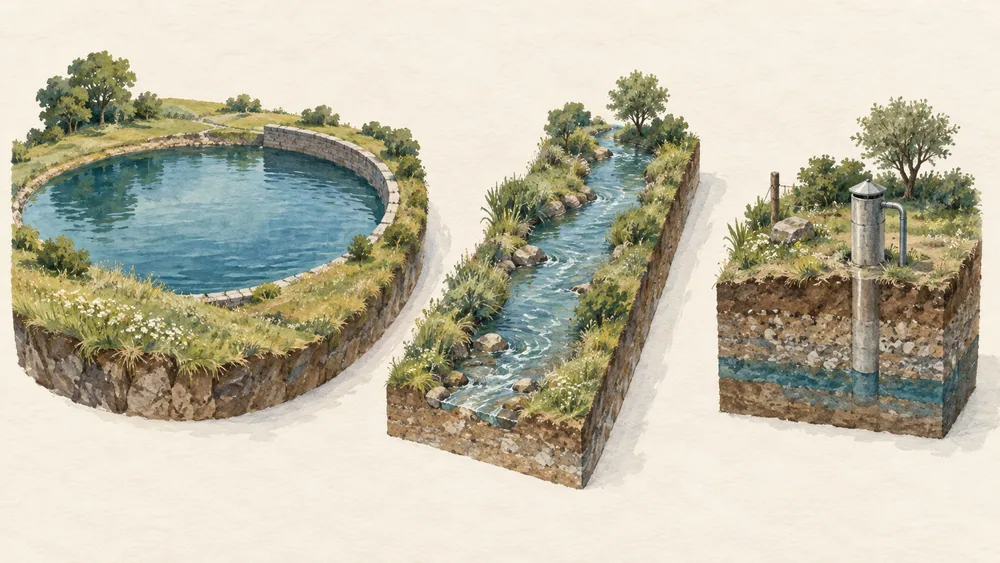
Bristol Water names Chew Valley Lake, Blagdon Lake, Cheddar and Barrow among its major reservoirs, fed from the Mendip Hills. It also uses the Gloucester and Sharpness Canal, whose flow comes mainly from the River Severn, and groundwater from boreholes, wells and springs. The utility's source description
The utility says it reduces reservoir use in drier conditions while taking more from the canal. That is a service-area operating description. It gives no fixed percentage for the water at the place where you are staying. Keep regional source information separate from an address-specific allocation unless the utility has actually provided that link. How the balance can change
The same distinction helps when reading a reservoir update. A storage snapshot has a date and a resource-management purpose. It cannot, on its own, tell you the condition of water leaving a treatment works or passing through a particular building's pipes. No current storage percentage is used as a quality finding here.
Treatment comes before the network
Its treatment overview describes screening raw water before it is pumped to treatment works. The overview then describes ozonation, coagulation and flocculation, clarification, filtration and activated-carbon adsorption. It also describes ultraviolet disinfection and a final chlorine addition for the onward pipe journey. The public treatment explainer
The stages belong to the public utility supply journey. Their description needs to stay attached to that scale. This is the utility's general explanation, not a verified process specification for every works. It supplies no evidence that a particular contaminant is absent at your accommodation, and it should not be read as a performance claim for a household filter.

Monitoring follows more than one point
Bristol Water describes sampling at sources and treatment works, with instruments monitoring water and treatment processes. It also samples randomly selected customer properties and provides postcode access to recent area results. How monitoring works
Keep the sampling point with any result. Water sampled before treatment and water checked later in the supply system have different settings. An area report also does not establish that the tap in your room was among the sampled outlets.
Its detailed-report index separates water-supply-zone PDFs from treatment-works PDFs. Select the relevant kind of report before interpreting its numbers. The report index
Follow the official detail for your address
Start with the supplier and postcode, then retain the returned area name and reporting period. If you need the source or treatment route for that address, ask for it specifically; leave the blend unassigned when the evidence only describes the wider service area. We have not obtained an address-specific routing result here.
Our Bristol city guide provides travel context. For a question about your accommodation, ask the supplier which report applies and retain its date and supply area alongside the result.