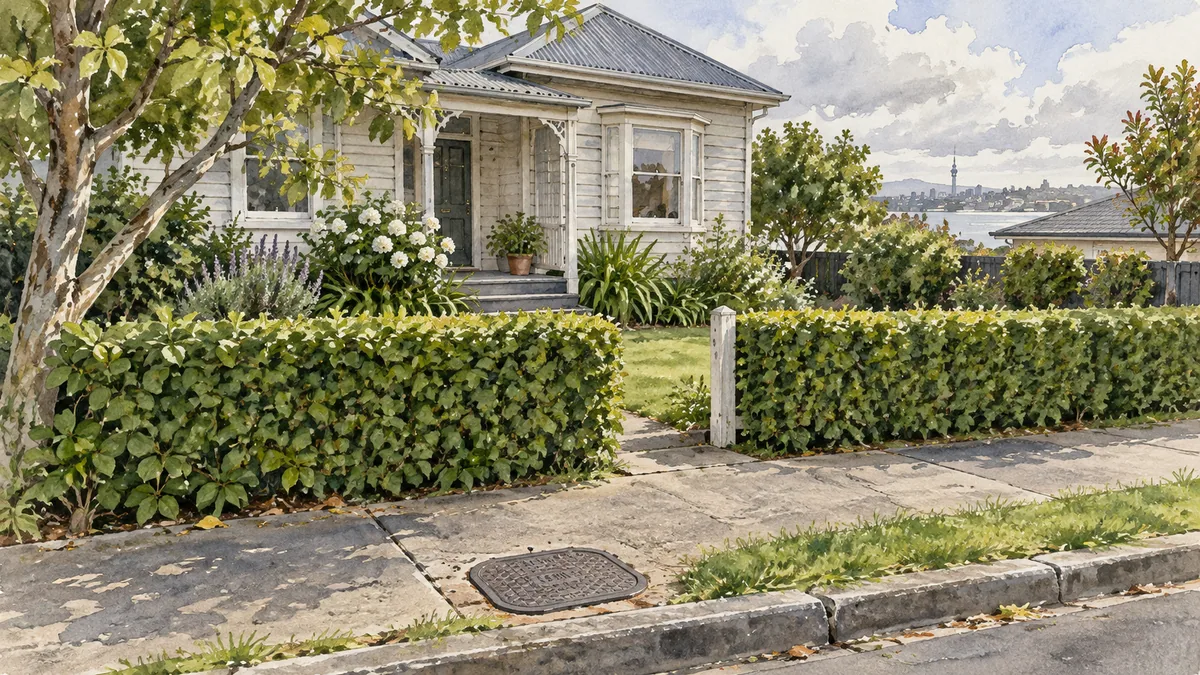
For Auckland properties connected to Watercare, check the meter layout when deciding who maintains a drinking-water pipe. The legal property boundary alone can be misleading. A meter may be inside the section, outside it, or part of a shared arrangement, so start with the published layout that matches the property.
Finding the point of supply
Watercare defines the drinking-water point of supply as the outlet of the meter fitting closest to the private pipe. That definition applies whether the meter is inside or outside the property boundary. The owner is responsible for maintaining pipes, fittings and devices on the private side. The utility's pipe-responsibility page includes separate examples for different meter arrangements.
Its outside-boundary diagram shows one house with a meter outside the legal boundary, and labels the public and private pipe sections. Use it to understand the relationship between those labels. It is an example, not a survey of your property; a shared master meter requires its own matching example.
Section 4.1 of the currently linked customer contract says owners must repair leaks on their side promptly. It also says tenants should notify the landlord or owner as soon as there is a problem. If you are staying in a rented apartment or hotel, reporting what you see to the person managing the property helps them establish the connection arrangement.
Checking a possible private leak
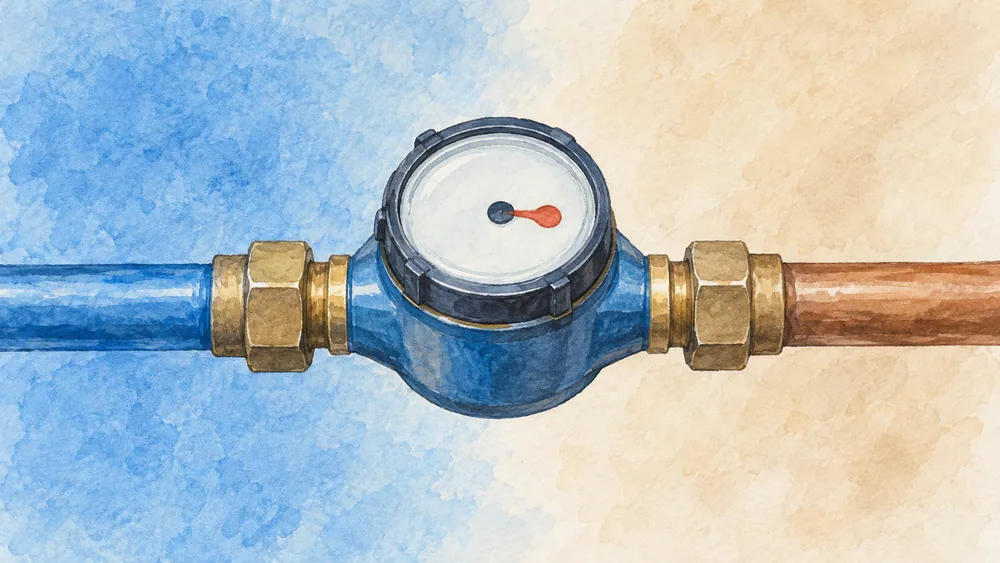
Check why a bill has increased before treating it as evidence of a leak. Watercare explains that an actual bill can be higher because it catches up with earlier low estimates. Its leak-check instructions then describe a meter test: record the reading, use no water for at least four hours, and compare it afterward. An increased reading indicates a likely leak.
For a meaningful comparison, everyone using the same meter needs to know about the test. Otherwise a normal use of water can make the reading move. The result cannot tell you where an underground pipe has failed or settle responsibility for a shared connection. Give the readings and circumstances to the property manager or plumber instead of treating them as a location map.
Reporting a public-network problem
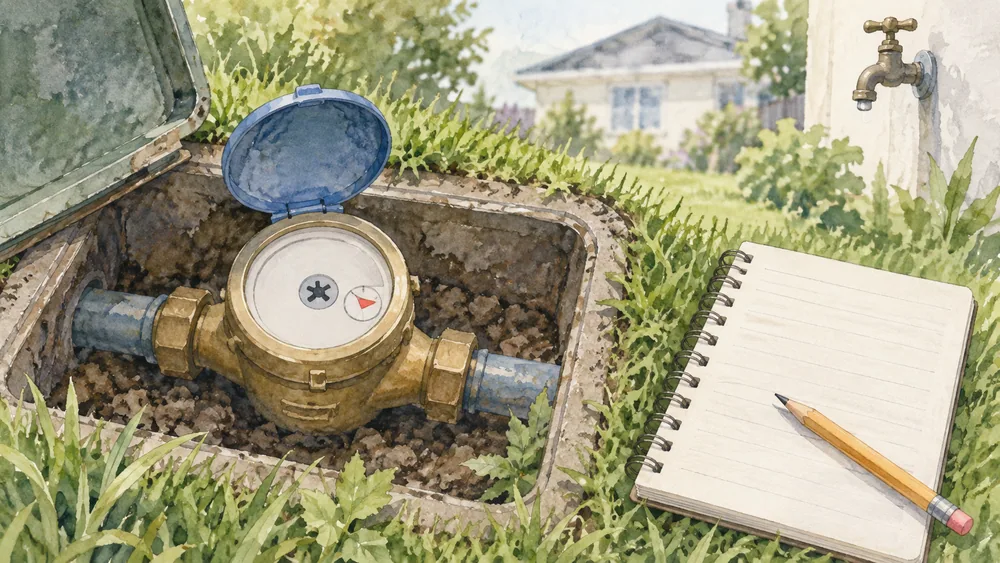
Watercare asks people to report a leak or burst pipe on public land, including streets and footpaths. It also accepts reports of wastewater overflows on private property. Its fault-reporting page directs readers to check current outages first and provide close-up and wider photographs. You can use its online reporting route or call (09) 442 2222 and press 1.
Describe where the water appears, when you noticed it and whether taps are affected. Leave the cause open for the utility or plumber to investigate. Follow the utility's instructions for the reported issue; this article does not establish that a particular street currently has an outage.
Rainwater and wastewater follow different routes
Watercare's water-type guidance explains that stormwater is rainfall runoff and public stormwater drains are managed by Auckland Council. Suspected wastewater overflow should be reported to Watercare even when it appears on private land. A puddle's appearance is only a clue; it does not establish ownership of a pipe beneath it.
For questions about drinking water during a stay, use the Auckland city guide alongside Watercare's current instructions. The location of a leak and the ownership boundary help route a repair request. They do not establish the quality of water at a particular tap.