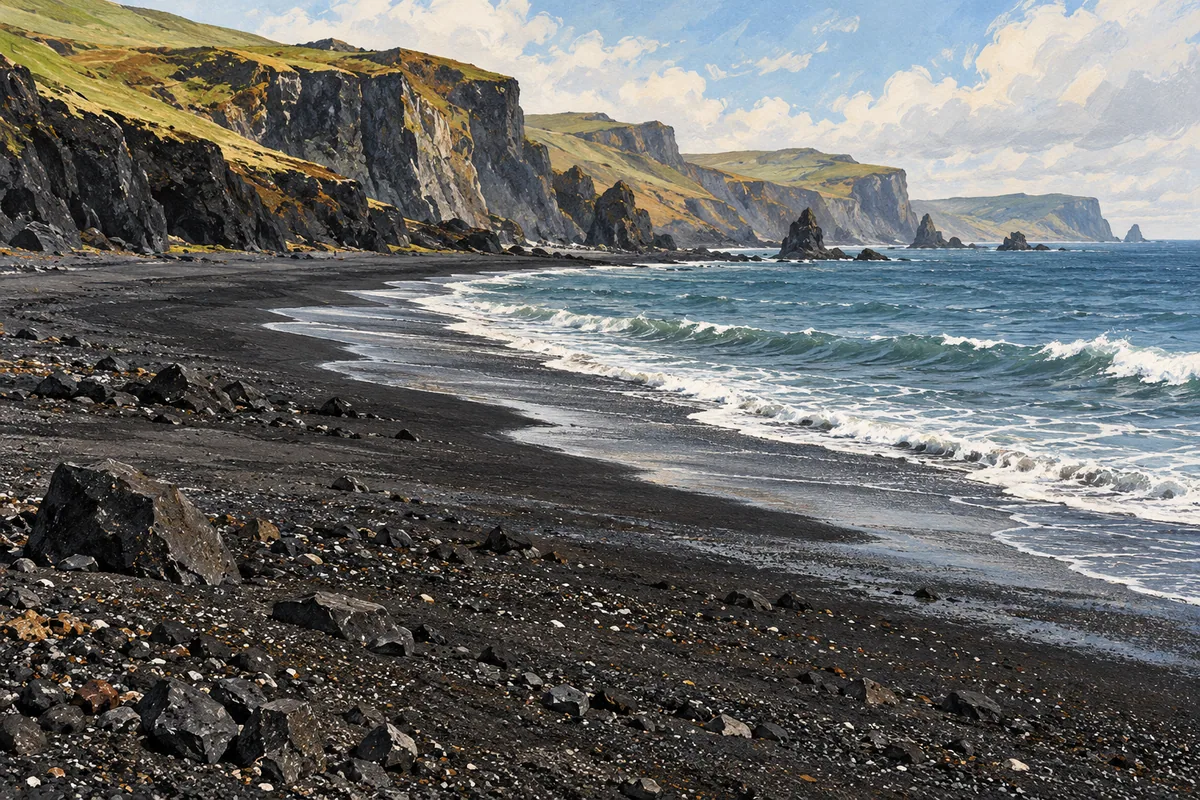
Beach sand looks black when dark rock fragments or dark mineral grains make up enough of the material you see. Volcanic rock can break into sand, while waves and wind can concentrate dense, dark minerals from a mixture of grains. The name black sand covers several materials, as the National Park Service's sand-colour guide explains.
When lava becomes sand
Basalt is a volcanic rock that often looks black. The word names a rock type, so a basalt grain is a small fragment of that rock. The National Park Service's basalt guide explains its volcanic origin and dark colour.
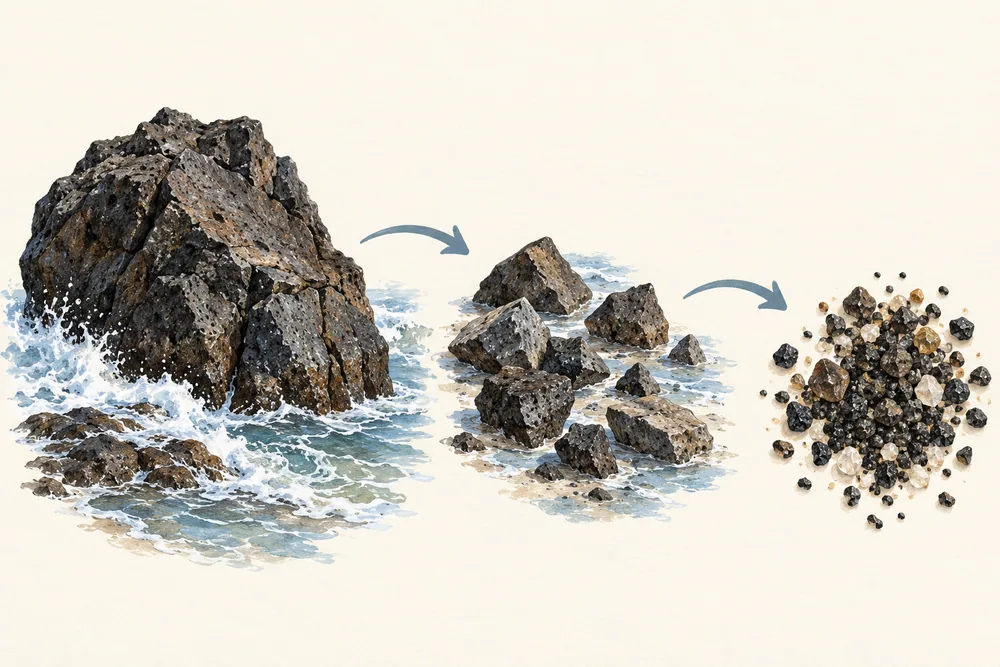
Once a lava flow has hardened along a coast, waves can wear it down into fragments that become beach sediment. Lava entering much colder seawater can also fracture into tiny pieces of black glass, which waves carry ashore. A dark beach does not necessarily come from a recent lava flow. The National Park Service describes both ways lava becomes sand.
How waves gather dark minerals
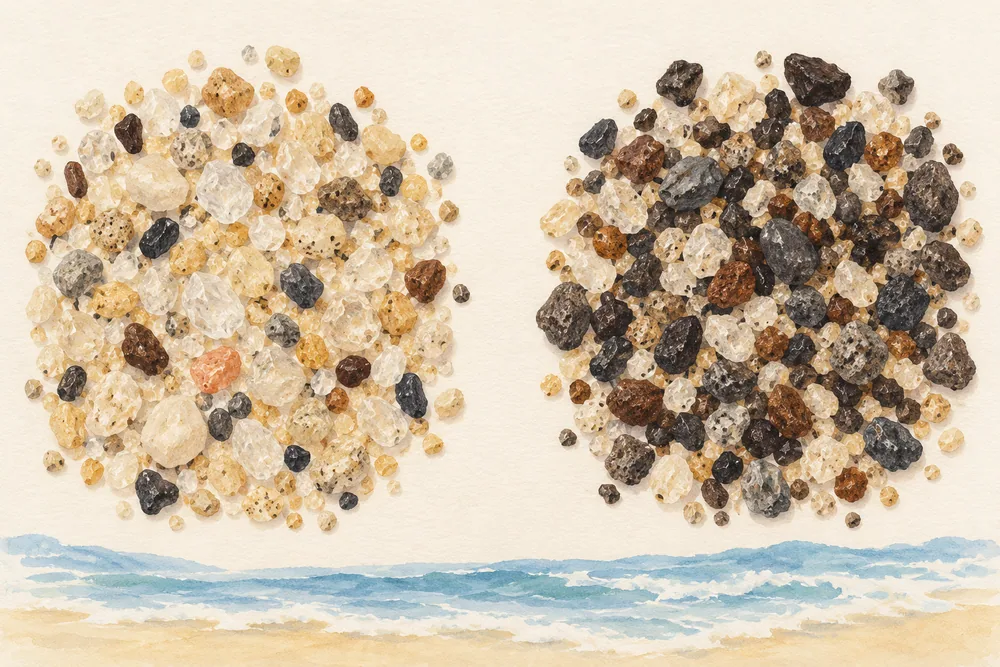
A beach can also have dark streaks within much paler sand. Magnetite and ilmenite are among the minerals found in these streaks on otherwise quartz-rich beaches. Quartz makes up much of the pale sand in those beaches; magnetite is black. The National Park Service's sand-colour guide shows these materials together.
Density means how much mass a material has in a given volume. Geologists call minerals such as magnetite and ilmenite heavy minerals because they are denser than common quartz grains. For two grains of the same volume, the denser one would weigh more. Geoscience Australia explains this comparison with quartz.
As rocks break down, they release mineral grains. These can come from granite, basalt and some rocks changed by heat or pressure. Streams can carry the grains towards the sea. Waves moving mixed sand up and down a beach can carry away lighter quartz, leaving heavier grains behind. Wind can also remove lighter sand and concentrate the heavy grains. Geoscience Australia describes this sorting process.
What the colour cannot tell you
Colour is one clue to a grain's identity, but it cannot tell you the name of every black grain. A mineral can occur in several colours, and identification also draws on hardness, crystal shape and the colour of a mark left on a test plate. The Utah Geological Survey explains these properties.
Where close examination of loose sand is permitted, a hand lens can help you compare individual grains. In its Great Sand Dunes teaching activity, the National Park Service uses a lens to observe grain colour and size. A closer view does not guarantee that you can identify every grain. Leave the sand in place and follow the location's rules.
Looking at individual grains
Browse folding hand lenses for a closer look at loose grains where examination is allowed. No model has been tested here, and a closer view does not guarantee mineral identification. Local rules still apply to handling and collecting sand.
🛒 Browse folding hand lenses on Amazon →Amazon paid link